
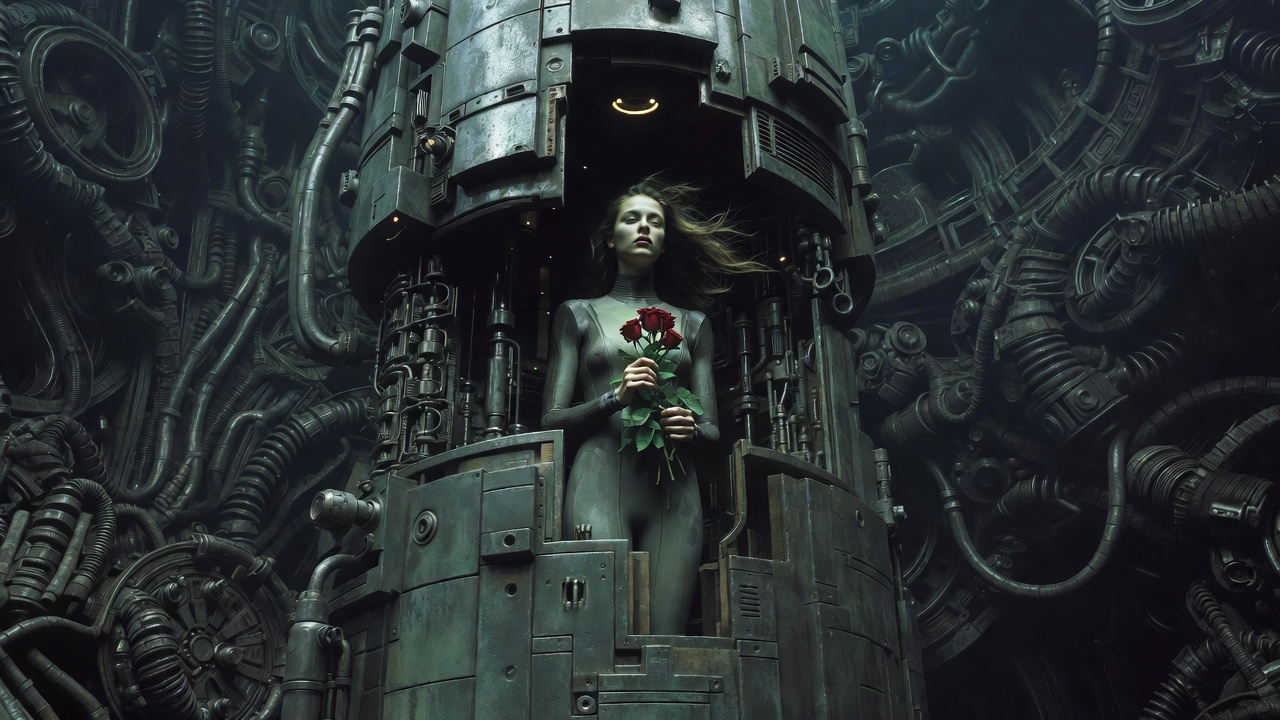
WHAT THE CYLINDER OF VAN TROFF UNDERSTANDS ABOUT PRESERVATION, SELECTION, AND THE FATE OF HUMAN BEINGS
The Cylinder of van Troff (Janusz Zajdel, 1980; untranslated) follows an astronaut (later called The Immortal) home from an interstellar expedition that ran two centuries late, into a future where humanity has survived in four places and rotted in each. On the Moon, a closed and fearful colony has atrophied bodily — generations in low gravity have left it unfit to return to the Earth it was preserving itself to reclaim. On Earth, the automated cities still feed and house a feral remnant that has atrophied mentally — no work, no purpose, no understanding of the machines keeping it alive. Below them, a hidden enclave of educated survivors has atrophied morally — it hoards books and science and uses its intelligence for nothing but its own perpetuation. And at the center is the astronaut’s own atrophy of hope: he came back for Yetta, who waited inside van Troff’s cylinder where time barely moves and finds her gone, leaving him only the choice to climb back into the device that took her and gamble forward.(full synopsis below)
The question Zajdel is really asking is not whether we can survive on another planet.
The question is: what is the thing that survives, and is it still us?
That is the blade inside The Cylinder of van Troff. The novel is about survival into unfitness: the strange horror of preserving one part of humanity so completely that the rest of it dies around the preserved piece.
Zajdel runs the same experiment at different scales.
The Moon colonists survive as a society and lose the body. Generations in low gravity leave them skeletally unfit to return to the very Earth they were preserving themselves to reclaim. Continuity of culture, loss of the organism. They kept the plan and lost the ability to enact it
Earth survives as infrastructure and loses the mind. The cities still feed and house everyone. The machines never failed. What evaporated was the human purpose the machines were built to serve. Continuity of the system, loss of the user.
Yetta survives as genome and loses the person. Sandra has the face, the genetic identity, none of the history. Continuity of the pattern, loss of the self. This is the intimate version of the same cut, and it is where the philosophical question stops being abstract and starts hurting.
Three vessels: society, infrastructure, body. Each preserves one variable by sacrificing another.
Zajdel decomposes “us” into separable parts and shows that you can save any one of them and still lose the thing you meant to save. Survival is real at every level and counterfeit at every level.
That is where the contemporary edge comes in. We are, right now, building systems meant to preserve and reconstitute the self: uploads, digital twins, models trained on a person’s corpus, the genome as backup. The promise is preservation.
Zajdel’s answer is nastier: preservation of what?
He is not interested in cosmic mystery. He is interested in the mechanics of control: how a system manufactures consent, manages information, and closes exits. The despair is structural.
The Moon is a closed, isolated society held together by permanent distrust of outsiders, where everyone spies on everyone and a stoked sense of external threat keeps the population in line. Yet the colony is not simply a surveillance state holding people by fear. The population has been biologically unfit to return. The lock on the door is physics.
That reframes the founding premise into its own trap. The colony was seeded with the best and brightest, with the explicit promise of eventual return to Earth. Generations in low gravity and thin air have quietly made the colonists’ bodies incapable of surviving the thing they were preserved for.
“You cannot go back” is not enforced. It is true.
The ones who refuse to believe it walk off the ship onto Earth and are crushed by their birthright world’s gravity. They die at the foot of the gangway. The return the entire colony was built around kills the people who attempt it.
What The Immortal finds on Earth is the gut-punch. The planet is covered by so-called Grill plates: an enormous system of solar cells that generate electricity and, through photosynthesis, food. Earth’s collapse arrives without a grand crash, riots, or revolt. The decay proceeds through top-down decisions and inertia in the structures of power. Plant life has nearly vanished. Plastic is everywhere. Life is fully automated. Robots provide food and clothing, so nobody has to work. People have turned aggressive and half-feral, with the young persecuting the old, blaming them for the state of the world.
The Moon gives us a people selected to go home, made physically unable to.
Earth gives us a home that no longer exists to return to: vegetation gone, Grill plates everywhere, the feral remnant left inside the machine.
The cylinder gives us the third closure. The device that was supposed to hold a person safe across the gap delivers that person to a world with no place for them.
Every mechanism meant to preserve return becomes the thing that voids it. The real premise is bleaker than “civilization decayed by inertia.” It was a sorting.
The fit, the bright, the useful were lifted off-world to the Moon with the promise of eventual return. The criminal, the cognitively impaired, the unfit were left behind on Earth, provisioned with the Grill plates and the robots and infinite supply, given everything and asked for nothing.
A humane-looking solution: nobody killed, everybody fed. Under the clean surface sits a two-ended eugenic disposal.
Both ends rot, which is the real argument of the book.
The Moon “elite” degenerates physically: low gravity, thin air, bodies that can no longer bear Earth.
The Earth remnant degenerates mentally, because a population given everything and required to do nothing, generation after generation, loses the thing that selection-by-difficulty was holding in place. Language collapses to a stub, or to nothing. They do not build or maintain. They break what is in front of them. The robots come out at night and patiently repair it, so destruction never accumulates into consequence, which is exactly why it never stops.
There is no feedback, no scarcity, no morning-after. Vandalism without cost stops being vandalism. It becomes the only activity left to a species with no friction to push against. That detail — the nightly repair — is the cruelest thing in the whole design, and the inverse of the gravity lock on the Moon.
On the Moon, physics makes return impossible.On Earth, the robots make degradation impossible to learn from. One population cannot go forward. The other cannot be made to. Comfort and difficulty both become traps; the book refuses to let either pole be safe. The Grill plates feed people who do nothing. The robots clean up after people who only destroy.
Abundance finishes humanity off gently, with full bellies.
Then comes the bunker: the third stratum, the one that breaks the clean binary and makes the whole thing darker rather than redemptive. You expect the holed-up scientists to be the remnant of hope: the ones who kept the lights on, kept the mind alive, the seed-bank of civilization waiting it out.
Zajdel refuses that completely.
The math-formula password is a beautiful piece of design because it compresses the book’s entire ideology into a lock. It is a filter that admits only the intelligent and bars the degenerate — the same sorting logic that created the two ruined populations in the first place, now reproduced voluntarily by the “good” survivors.
They have built their own miniature version of the original crime: a wall that sorts humanity by capability and keeps the unfit out. Same instinct, smaller scale. The sorting was not a one-time historical error. It is what intelligent people do when frightened, and they will do it again the moment they are cornered.
What waits behind the lock is the killer. No project. No plan to restore Earth or recall the Moon or rebuild language. Just perpetuation. They solve the problem of continuing to exist and then do nothing with the existence.
Now there are three bins. The bunker is the one that hurts most because it had the means to choose otherwise and chose perpetuation instead. The book closes every exit: the Moon cannot return because of body; the Earth surface cannot think because of mind; the bunker will not reach because of will.
Brilliance, like comfort and physics, preserves only itself.
The top of the intelligence gradient and the bottom of it converge on the same use of a cloned woman. Intelligence buys the bunker a harder password and better hygiene, but not one ounce of meaning. They are as much a dead end as the furniture-breakers and the gravity-trapped, just a dead end that can do calculus.
The Immortal threads through all of this in the cylinder.
He is the only one watching both processes run to completion: the one man who can still take Earth’s gravity, still has a working mind, still has a working language, moving through a planet split between people who cannot think and a Moon full of people who cannot return.
That makes the cylinder his final act — the only refusal of the sorting in the whole book. Everyone else accepted their bin. He will not.
He has seen all three terminal forms of the species and found no future in any of them. So, realizing he will never find Yetta, he shuts himself inside the cylinder — meaning to ride it into the future, acquire the technology to reverse its flow of time, and carry himself back to the moment he first left for space. He walks back into the very thing that ruined him, toward no promised destination, only past this, on the bare hope that whatever the next opening reveals might be better.
It is not faith. It is not a plan. It is the refusal to accept any available ending as the ending.
The cylinder stops being a love-preservation device or a time machine.
It becomes the only posture left to an intelligent being who will not sort himself into a bin: keep the door shut, keep moving forward, gamble on a later world.
The frame tells us that a thousand years on, people from Filia do arrive on the emptied Earth, so the gamble is not quite nothing. Just nothing he will ever know he won.
The structure is foreclosure and replacement.
Earth does not die in fire. It is quietly administered into a vegetationless solar-panel monoculture.
The one irreplaceable person is replaced, cloned, sold. The cylinder, sold as the device that preserves love against time, becomes the instrument of its total loss.
The return the whole novel is built around is revealed to be impossible.
And it indicts the original “smart” decision retroactively. The sorting was made by the best and brightest, the rational humane fix to overpopulation and scarcity. It produced two dead-end species, neither able to be the future. The people who engineered the solution exiled themselves to a gravity well they cannot climb out of. The people they wrote off are still down there breaking furniture for robots to fix.
Nobody is coming back.
That is the Epoch of Fission the 24th-century historian is squinting at through The Immortal’s notebook: no war, no great collapse, only a clean administrative decision to divide humanity by worth, after which both halves quietly stopped being able to be human.
The argument is brutal: every human response to catastrophe — evacuate the worthy, pacify the worthless, wall off the smart — sorts the species into compartments where it quietly stops being able to be itself.
The only unsorted move left is to refuse to land.
THE CYLINDER OF VAN TROFF synopsis:
The Cylinder of van Troff is told as a future document. Long after the fall of old Earth, an archaeologist named Akk Numi finds a green notebook written by an unnamed astronaut from the 21st century. Akk translates and comments on it, calling its author “the Immortal.” Later, Akk himself disappears, and his friend Le Diaz publishes the material, trying to explain what happened to him.
The notebook begins with the astronaut waking on the Moon after returning from an interstellar expedition. He had left Earth aboard the starship Helios, part of a crew sent to explore the Dzeta system. The mission was long and dangerous. Several crew members died, and on the way home the ship’s engines failed, making the return take far longer than planned. By the time the surviving crew reaches the Solar System, about two hundred years have passed on Earth.
Before the expedition, the narrator had been in love with a young woman named Yetta. A brilliant physicist, Professor van Troff, had invented a secret machine: a cylinder in which time passes much more slowly than outside. Van Troff convinces Yetta to wait for the narrator inside the cylinder. For her, decades would pass as minutes. The narrator leaves Earth believing that, when he returns, Yetta may still be young and waiting for him.
When the Helios crew returns, they are intercepted by lunar colonists and taken to an underground Moon settlement. The people on the Moon explain that Earth has changed catastrophically. Humanity split during the crew’s absence. Some people fled to the Moon to preserve themselves, while those left on Earth supposedly underwent biological and social degeneration. The lunar authorities say Earth is too dangerous and forbid the astronauts from going there.
The astronauts soon realize they are not guests but prisoners. The Moon society is itself damaged: it is authoritarian, fearful, physically weakened by low gravity, and ruled by a Council of Experts. Some lunar dissidents secretly contact the astronauts. They want to return to Earth, but after generations in lunar gravity they may no longer be able to survive Earth’s gravity. They also do not know the truth about Earth because the Council controls information.
The narrator escapes the Moon and reaches Earth. He finds not a dead planet, but a dying civilization. The great automated cities still function, feeding and housing people, but human society has collapsed into passivity, violence, tribal slang, and decay. Machines continue to maintain life without any real human purpose behind it. Most people no longer understand the systems that support them.
The catastrophe turns out to be connected to old attempts to optimize humanity. Automation, genetic engineering, social planning, and reproductive control have produced a population that is sterile, directionless, and dying out. Women have become extremely rare. Humanity on Earth is not simply “degenerate” in a crude sense: it is the ruined product of systems designed to solve hunger, overpopulation, and social disorder.
While searching for Yetta, the narrator meets Mark, one of a small group of educated survivors hiding in the lower layers of the city. These people preserve books, science, food, and fragments of old culture, but they are also decadent and isolated. Mark helps the narrator navigate the city’s buried levels. Newer cities have been built over older cities, so the old world survives literally underneath the new one.
The narrator reaches the old Institute where van Troff hid the cylinder. He descends into the secret chamber and opens it.
Yetta is not there.
Inside the cylinder he finds only a fresh bouquet of roses. The flowers prove she was inside recently according to cylinder-time, but they do not explain when she left or where she went. The narrator realizes that Yetta may have entered and exited the cylinder many times, waiting for him across centuries, each absence outside costing her huge amounts of historical time.
He continues searching. Eventually he meets Sandra, a young woman who looks almost exactly like Yetta. At first this seems like a miracle or a substitute granted by fate. Then the truth emerges: Sandra is one of a series of cloned or genetically reproduced women. Yetta had left the cylinder at some point, fallen into the hands of scientists, and become the biological source for these copies. Sandra is not Yetta, but she carries Yetta’s face and genetic identity. This makes the narrator’s love unstable: he wanted one woman, but the future gives him echoes.
The narrator also discovers that the cylinder’s time-distorting field affects the space beneath it. In old tunnels below the machine, rats have been caught in a slowed-time field, suspended almost motionless. This proves van Troff’s invention is more powerful and more dangerous than anyone understood.
As the story continues, it becomes clear that old Earth is finished. The Moon people are also doomed, because after generations in low gravity they are no longer fit for Earth. The Earth cities are dying. Humanity’s real future lies elsewhere: in distant colonies founded by earlier expeditions, especially the colony of Philia. In the far future, people from Philia return to Earth and begin studying the ruins.
Akk Numi, the future archaeologist, becomes obsessed with the Immortal’s notebook and the cylinder. He realizes the narrator may have survived across vast stretches of time by repeatedly using the cylinder. He also suspects that the cylinder might eventually allow not only travel forward through time, but perhaps backward, if future science learns how to reverse van Troff’s principle.
Then Akk disappears.
Le Diaz investigates Akk’s disappearance and follows his clues. He has someone search old lunar libraries for ancient science-fiction books. One book turns up with an impossible title: The Cylinder of van Troff. Le Diaz opens it and realizes it contains Akk’s writing. Then he reads further and sees something even stranger: the introduction is his own. The book he is preparing in the future has already appeared in the past.
The ending reveals that the entire novel is a closed time loop. The Immortal, Akk, Le Diaz, the notebook, and the published novel are all part of the same temporal knot. The book does not simply tell the story of the cylinder; the book itself is evidence that the cylinder’s loop has already happened.
