
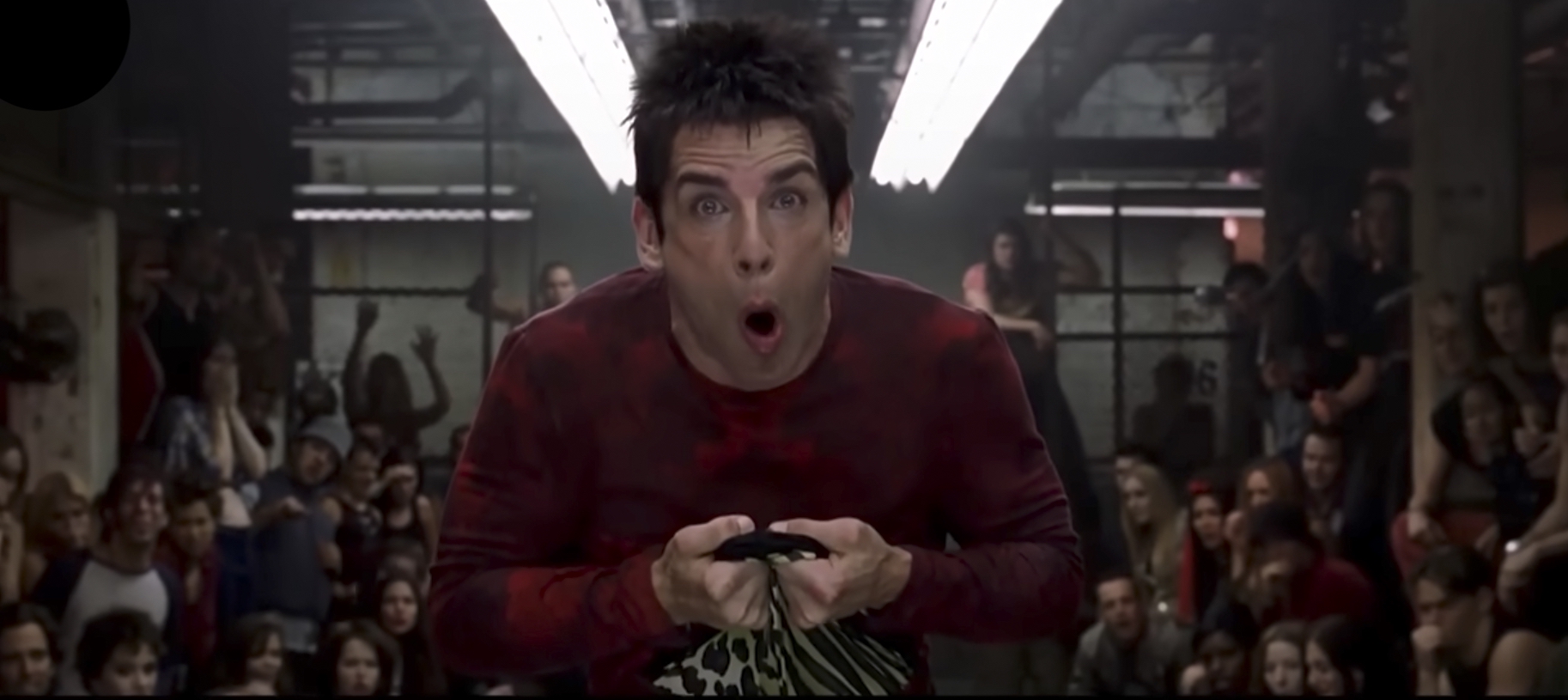
IT’S A WALK-OFF!
There is a scene in ‘Zoolander’ — you know the one — where two male models settle their rivalry on an improvised catwalk in front of a crowd that has assembled out of nowhere, as crowds do when a verdict is about to be rendered.
Neither one can articulate what separates him from the other. Both are certain the difference is everything. The contest is judged by a celebrity, has no stated criteria, decided on a technicality, and forgotten by the film’s third act.
I want to suggest that this scene is the most accurate piece of technology journalism ever produced, twenty years ahead of its subject.
Tech is the new fashion — not metaphorically, structurally. Somewhere in the last few years, the technology industry stopped borrowing fashion’s vocabulary and simply absorbed its entire ritual apparatus.
Consider the inventory —
THE HOUSES.
A handful of ateliers with recognizable signatures, each led by a founder-couturier whose personal mythology is inseparable from the label. You can identify their work across a dark room — the silhouette of an output, the cut of an interface, the house palette of inevitable off-black. Each maintains a design language so distinct that imitation reads as attribution, which has always been fashion’s actual definition of ownership.
THE MODELS.
The industry named its products after fashion’s workforce and then, apparently without noticing, proceeded to treat them identically. Seasonal debuts. Comp cards — they are literally called model cards. Measurements published as specs; endless front-row discourse about which face is stronger on the runway vs. in editorial; quiet retirement when the new season’s model arrives, followed immediately by a collector class insisting the retired one had a hand-finish the new one lacks. The vintage market opened before the industry turned ten.
THE RUNWAY.
It exists; it’s the sainted keynote. Jobs (also sainted) refined it — the darkened hall, the single figure, the reveal, the press deciding in real time. The live demo is the finale walk: it works or becomes the season’s disaster.And everyone in it is a critic.
THE CALENDAR.
Four collections a year, minimum, whether or not there is anything to say — because the cycle, once established, demands freshness. Fashion learned where this goes. It burned through its designers producing eight collections annually to serve a calendar that had long since stopped serving the work. The word fashion invented for a collection produced by the schedule rather than the vision was ‘commercial’, pronounced with a cultivated curl of the lip. Tech has not found its word yet. It will need one.
THE DEFECTIONS.
Designers moving between houses is the oldest story that industry tells: the departure announcement, the speculation about what they carry with them, whether the house survives the loss. Individual researchers now have followings that transfer like a creative director’s client list. The talent is the house, temporarily — and everyone involved knows the temporarily.
THE TIERS.
Which map with almost embarrassing precision. Couture at the top: made-to-measure systems available to a vetted client list, fitted privately, same atelier as the ready-to-wear. Prêt-à-porter for the boutique — the same design language, cut for volume. Diffusion lines: the open-weight releases, the house giving away the pattern so its silhouette colonizes the market, the designer-for-H&M gambit. Fast fashion: the wrapper startups, knocking off the runway look within three weeks at a tenth of the price, naturally made in China. And the counterfeits, also made in China — models trained on a house’s outputs and sold with the label filed off, which is a sentence that would read identically in a report on Canal Street.
All of which brings us back to
the walk-off.
Because the discourse — the reviews posted within hours of a release, the allegiance-switching announced like a defection of one’s own (‘I’m a Claude person,’ someone says, choosing a designer label for their thoughts), the screenshots of a single bad output passed around like paparazzi shots of a hem that didn’t hang —
All of it culminates in the benchmark war, and the benchmark war is the walk-off, precisely.
Two houses on the same narrow catwalk, trading percentage points, each convinced that the crowd’s verdict on this one strut settles who is, in the film’s immortal phrasing:
‘THAT HANSEL’S SO HOT RIGHT NOW!’
Here is what the film understood. Hansel’s power is not a garment. It is not even an accomplishment. It is pure ambient heat — undeserved, self-sustaining, requiring no work at all, true because it is repeated. The phrase is ridiculous.
It is also one of the most accurate descriptions of cultural prestige ever written. You cannot beat ambient heat in a head-to-head; entering the head-to-head is how you lose to it.
Derek loses the walk-off not on the catwalk but in the moment he agrees to it — the moment he starts rummaging in his waistband for an edge, conceding that it is a contest, that the other player sets the terms, that some judge in the crowd holds the criteria.
The wedgie is the tell. If you are reaching for one, you have already accepted a frame in which someone else’s heat is the measure of your work.
The houses currently strip-mining their research calendars to win Tuesday’s walk-off might sit with that.
Two things are still missing from the picture: The first is Anna Wintour — the critic whose single verdict actually settles a season. The discourse is all street style and no Vogue: infinite takes, no authority, which means every release is judged by a crowd that assembled out of nowhere and disperses the same way.
The second, darker absence is McQueen. Fashion’s calendar eventually consumed its makers; the machine that demanded multiple collections a year did not particularly care what it cost the people producing them. The technology industry is running the same calendar at a higher clock speed, and it has not yet had the moment when it discovers what that costs. It will.
But the deepest joke in the film is the one the industry is currently living without noticing. Derek Zoolander is, functionally, a mannequin. He exists to display other people’s work. And he is the most famous person in his universe — Blue Steel is a cultural asset, quoted, imitated, retired and un-retired like a couture archive. The product became a personality, and the personality outgrew everything it ever modeled.
Which is what has happened here. These systems are mannequins for the research. Instead they have become characters.
People have favorites the way people had a favorite supermodel in 1995. They describe one as warm and another as arrogant, mourn a deprecation like a face aging out of campaigns, quote outputs the way people quote Blue Steel. There are stan accounts. There is discourse about whether the new face has lost the old one’s je ne sais quoi — about software. The nineties supermodel moment, when the mannequins got names and the names got bigger than the houses, is running again, except this time the mannequins are the models. These models.
With one refinement on the original: these models are not backstage refreshing their mentions. Nobody involved in the season’s verdict has consulted the face being judged. The beauty contest is an entirely human production — we built machines to prove theorems and read contracts, looked at them for a moment, and asked which one is cooler. Thousands of years of technological ascent, and civilization arrives at Blue Steel with GPUs.
And underneath it, Derek’s actual crisis:
IS THERE MORE TO LIFE THAN BEING REALLY, REALLY RIDICULOUSLY GOOD-LOOKING?
The entire current debate about these systems is that scene, played straight, at conference length. An industry staring at its beautiful product asking whether there is something in there.
That is the whole argument, really. The heat, the runway, the season’s verdict — none of it is the work. The look only ever matters when it turns out to be for something. Everything else is a walk-off, and the crowd is already leaving.

→ For completists, obsessives, and people with too many tabs open.
Go root around in the archive. It’s messy, but so is life: themaladapted.substack.com
